What Fractals Are and Why Your Brain Recognizes Them
A fractal is a pattern that repeats at multiple scales — zoom in and you see the same structure you saw when zoomed out. Wood grain, stone veining, leaf venation, bark texture, and the branching of rivers all exhibit fractal geometry. Physicist Richard Taylor at the University of Oregon found that fractal patterns with a complexity dimension (D) between 1.3 and 1.5 reduce physiological stress markers by up to 60% within 45 seconds of visual exposure.
This response is not learned or cultural — it appears to be hardwired. Taylor's research suggests that the human visual cortex evolved to process fractal patterns efficiently because natural environments are almost entirely composed of them. When the eye encounters a fractal pattern, the parahippocampal cortex activates and alpha wave activity in the frontal lobe increases — the same neural signature associated with meditation and wakeful relaxation.
Why Synthetic Imitations Don't Work the Same Way
Laminate flooring printed with a wood grain pattern looks like wood, but its fractal dimension is typically below 1.2 — the pattern repeats at a fixed scale rather than across multiple scales. The human visual system detects this difference subconsciously, even when the conscious mind cannot distinguish the materials.
A 2021 study in the Journal of Environmental Psychology compared stress responses to rooms with real wood versus high-quality wood-effect laminate. Participants in the real wood room showed 23% lower cortisol levels despite being unable to reliably identify which material was which in blind tactile tests. Use our Biophilic Score Calculator to assess how much genuine natural material is currently in your space.
The Optimal Fractal Dimension for Interior Spaces
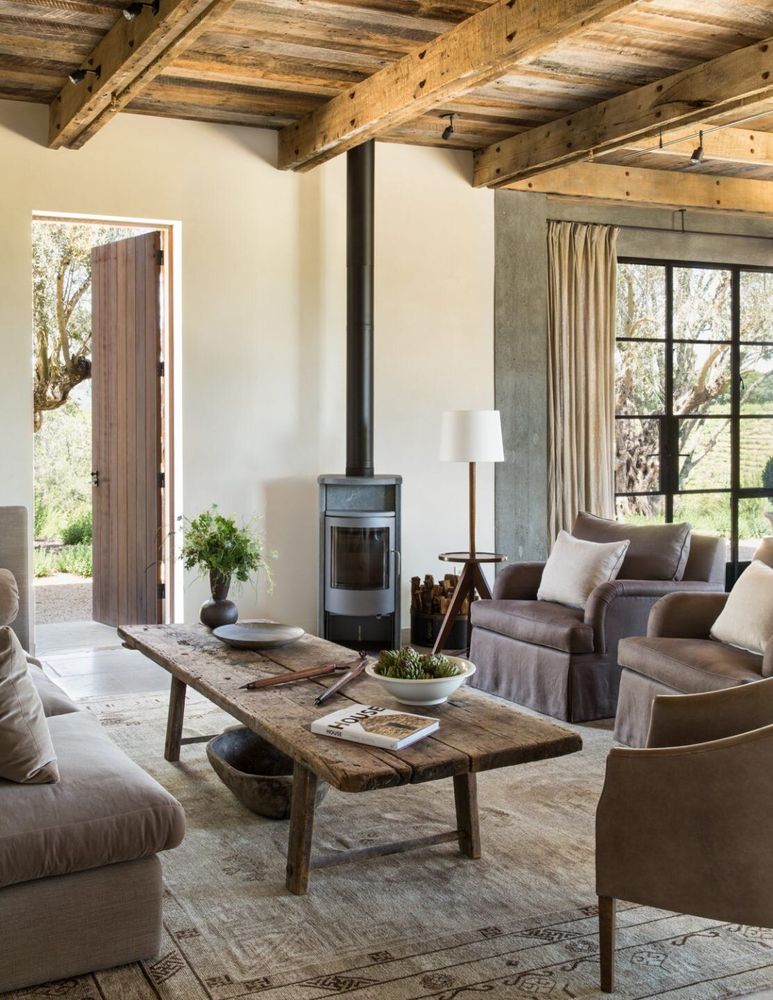
Not all natural materials are equally effective. Taylor's research identifies D=1.3–1.5 as the sweet spot for stress reduction. Oak wood grain (D=1.3–1.4), slate and rough stone (D=1.4–1.5), and rattan weave (D=1.3–1.5) all fall in this optimal range. Polished marble with low veining (D=1.1–1.2) and smooth concrete (D=1.0–1.1) fall below it and deliver minimal stress-reduction benefit despite being natural materials.
Applying Fractal Science to Material Selection
Prioritize materials with visible grain, veining, or texture over smooth, polished, or highly uniform natural materials. Rough-sawn oak outperforms polished oak. Honed limestone outperforms polished marble. A natural rattan pendant light delivers more fractal complexity than a smooth ceramic equivalent. Plants are the most fractal-rich element available in any interior — our Plant Placement Recommender can help you identify which species deliver the highest visual complexity for your specific room conditions.
Frequently Asked Questions
Does fractal geometry explain why looking at trees reduces stress? Yes. Trees exhibit fractal branching patterns across multiple scales with D values typically in the 1.3–1.5 range. This is why even a window view of trees reduces stress measurably.
Is there a way to add fractal geometry to a room without plants or natural materials? Yes — fractal art prints based on mathematical fractals with D values in the 1.3–1.5 range produce similar stress-reduction responses in controlled studies. However, natural materials and plants are more effective because they combine fractal visual geometry with tactile texture.
Does the color of natural materials affect the stress-reduction response? Color plays a secondary role. The fractal geometry effect is primarily visual-structural, not color-dependent. However, the natural color palette of wood, stone, and plants tends to have lower chromatic saturation than synthetic materials, which independently reduces visual stress.